They perch gently on concrete ledges. They nestle into peeling stucco. Occasionally, they soar across a stone house's rooftop.
A flock has landed in Wang Tong Village, a peaceful corner of Lantau Island on Hong Kong’s southwestern edge. But this flock is unlike others: Its birds are made of paint.
They exist on murals designed for a larger purpose - not merely to draw attention to forgotten places but to tell the story of the extraordinary journeys birds undertake.
Dominic Johnson-Hill, who envisioned the flock, was captivated by an account from his ornithologist neighbor about the Amur falcon, a bird that travels from Manchuria, pauses in Lantau, then continues its migration across Myanmar, India and Madagascar to South Africa.
"I just assumed these birds lived on the island,” Johnson-Hill recalls. "But they’re not. They’re passing guests.”
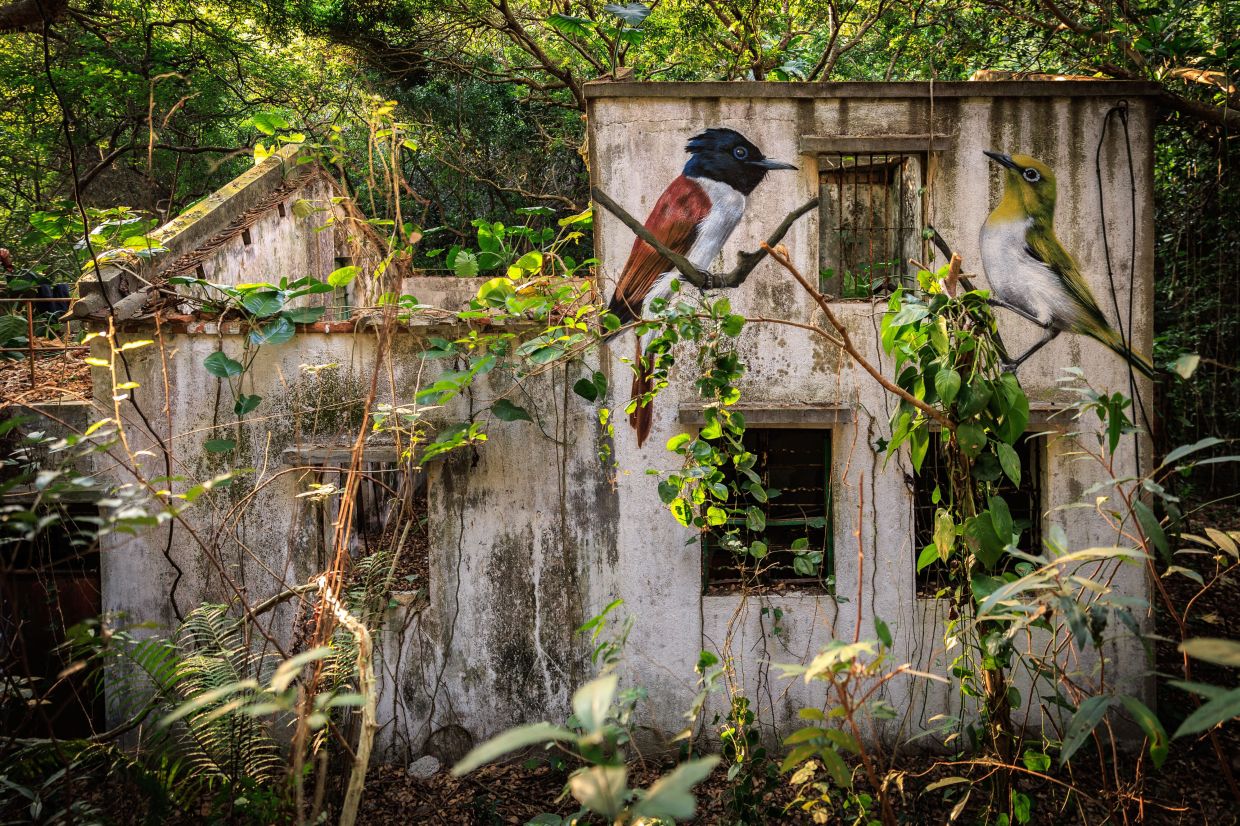
That sense of wonder became the seed for what became the Flock Project. Johnson-Hill looked at the abandoned house next to his own and imagined a red-billed blue magpie painted across the wall. "They just seemed to belong there,” he says.
To bring the vision to life, Johnson-Hill sought out someone who could paint birds not just accurately but with soul. He found British artist Rob Aspire, known as "The Birdman” for his intricate, expressive murals of birds.
One bird led to another. A year later, Johnson-Hill invited Aspire back and commissioned seven more murals.
Each bird was chosen for its ecological presence, visual harmony or symbolic resonance with place. A kingfisher keeps watch over a stream where fishing is no longer allowed. A Swinhoe’s white-eye blends into the walls near trees where its bright, fluting call still echoes.
All the murals are painted on abandoned homes except one. High on Sunset Peak, 868 meters (nearly 3,000 feet) above sea level, a long-tailed shrike perches naturally on the rooftop of a 90-year-old stone house, watching the mountains unfold below.
The goal is to gradually bring more of Hong Kong’s native and migratory birds into view, nestling them into forgotten corners of the island as if they had always lived there.
The murals draw hundreds of people, many from Hong Kong's concrete heart. They wander the trails and alleys of Lantau’s quiet corners. On weekends, some bring chalk and mark out arrows, turning village paths into treasure maps for the next bird hunter. Sometimes noticing beauty is the first step toward wanting to protect it.
Johnson-Hill has created an online map for visitors and is planning the next phase. What comes next depends on what reveals itself - a derelict house brought to his attention, or the conditions that make another bird possible.
Birds migrate. They disappear. Sometimes they return, sometimes not. People are the same way. Villages empty, but the walls remain - with a painted bird, or the memory of one. — AP