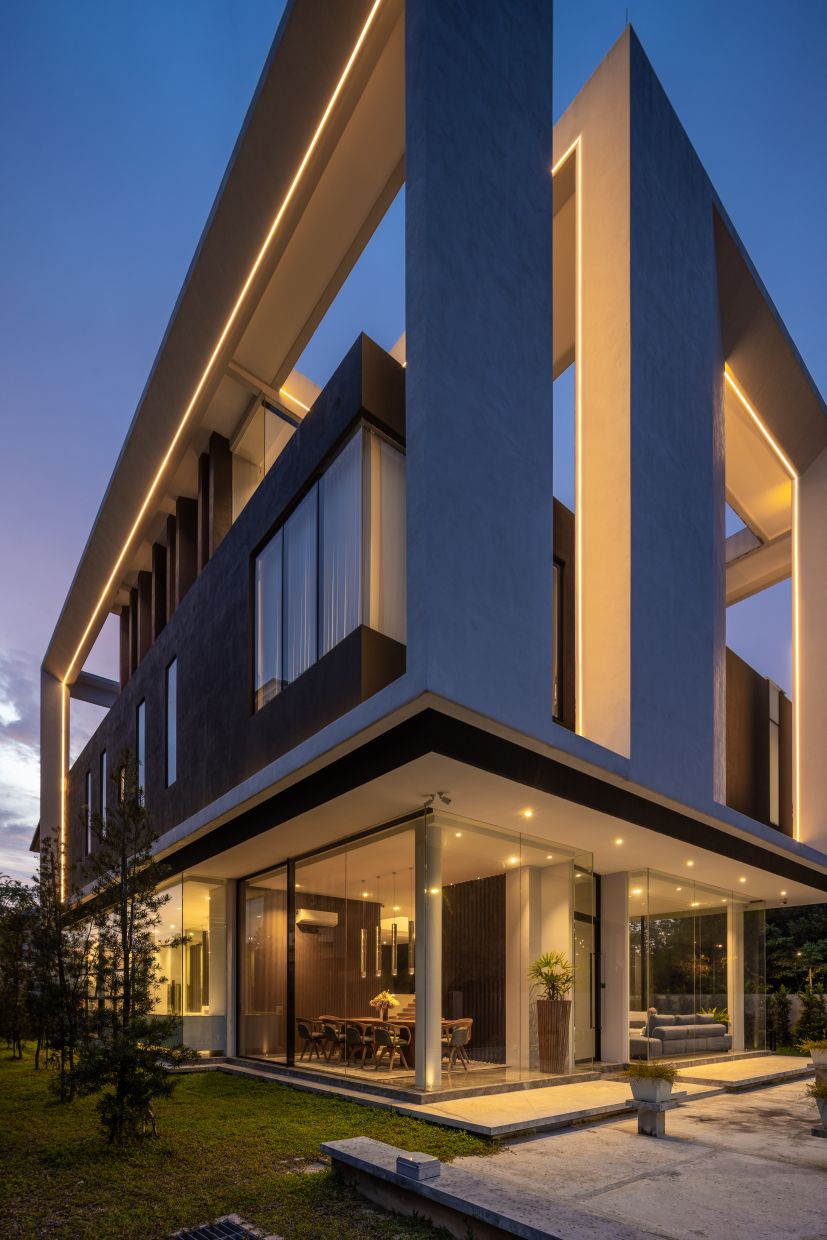
When viewed from the outside, the Float-Box House – located on a 750sq m angular plot surrounded by the lush Kota Damansara Forest Reserve – appears to be levitating above ground.
But that’s not magic.
It’s an optical illusion, a feat of architectural ingenuity and engineering precision combined with careful planning and a solid client-architect partnership.
White volumes hover above a shadowy base, while long planes extend with unexpected lightness. Glass meets the landscape with almost no visible thresholds.
The house seems less like a static object and more like a carefully poised gesture; suspended, deliberate and quietly confident.
“The ground floor is fully glazed, with subtle hidden pillars interspersed between,” explains architect Looi Mun Keat of MK Looi Architect.
“This provides uninterrupted views and a seamless connection with the landscape, while facilitating cross ventilation.
“Conversely, the upper floors of this three-storey home are defined by a sturdy, solid concrete form, making the support seem ‘invisible’, resulting in the ‘floating’ effect.”
It is no surprise then, that this project clinched one of Malaysia’s most respected architectural honours, the PAM Gold Award 2025 in the Single Residential category.
“We’ve built the homeowner’s first house, so trust was already established,” Looi explains. “But this time, he wanted something different: a smaller house and a very conceptual approach.”
The brief was simple, but the site had some challenges. The plot comprised a square shape fused with a triangular corner, creating a non-conventional perimeter that homeowners might find difficult to optimise. But for Looi, this odd geometry became an opportunity.
“During our initial visit, we were immediately captivated by the site’s unique angularity and its proximity to the forest reserve,” he says.
“Despite its modest size, the irregular shape and surrounding natural beauty presented both a challenge and an opportunity to design a home that doesn’t just respond to its environment, but becomes an intrinsic part of it.”
“The homeowner wanted the triangular space to be part of the landscape. And he didn’t need a big house this time. So we optimised the square portion and kept the triangle for a garden.”
The mission became clear: compact yet expansive. Let the garden become part of daily living and push the concept as far as structurally – and visually – possible.
The idea of a floating house didn’t arrive instantly. Instead, it evolved from a desire to keep the ground floor as open as possible, allowing it to connect seamlessly with the triangular garden.
“Why not open up the whole ground floor?” Looi recalls thinking during early discussions.
From that question, the central idea took shape: a solid, private upper box resting over a transparent, fluid void below.
In architectural terms, he describes this as the interplay of solid and void; a recurring theme that later influenced the facade, spatial planning and even furniture detailing.
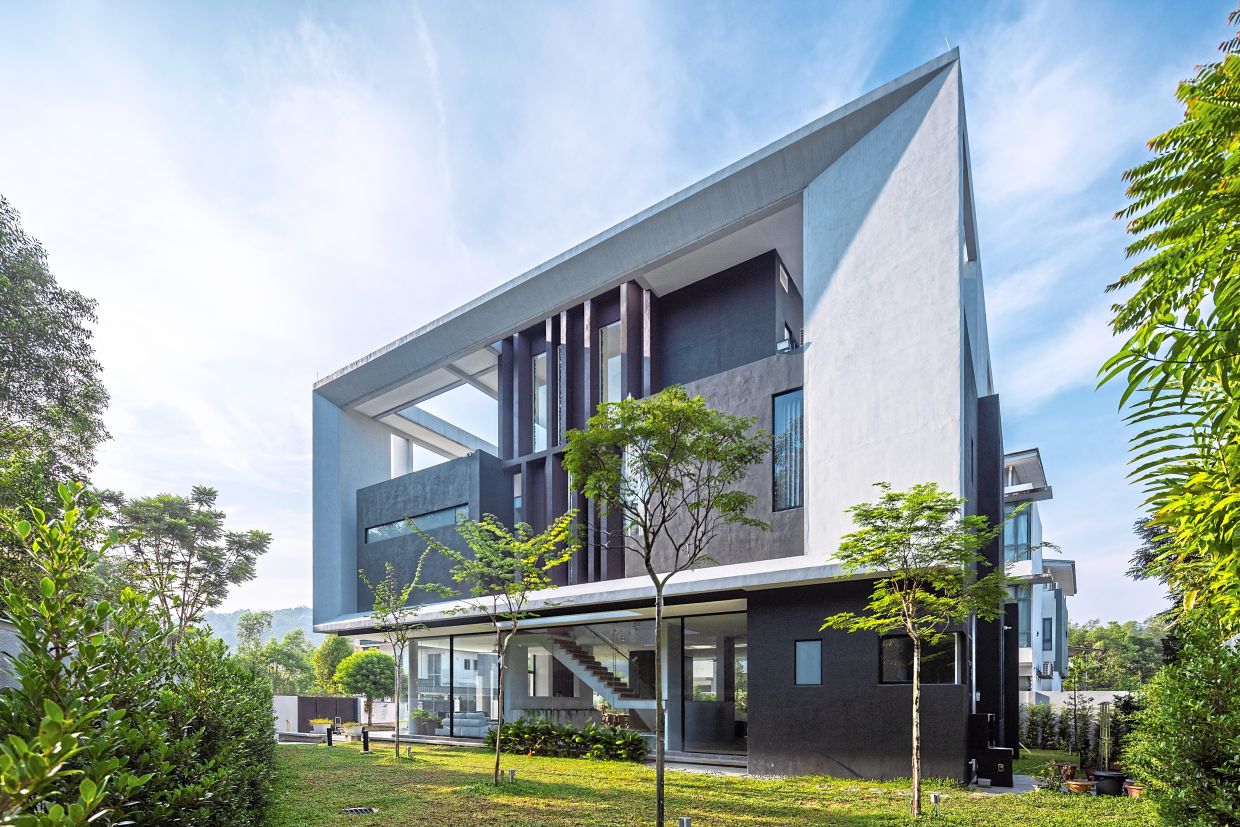
The right elevation reveals a striking composition, in what Looi calls “a box within a box” concept.
A large white box envelops smaller dark boxes, the former serving as the unifying form, while the darker ones contain curated spaces within the structure.
The ground floor, composed almost entirely of glass, dissolves boundaries between interior and landscape. Sliding doors run continuously along the edges, creating a visual flow that blurs the indoor and outdoor.
“Given the site’s size, our approach was to blur boundaries on the ground floor,” he says. “By creating a transparent transition between interior and exterior, the space feels like a seamless extension of the outdoors.”
This openness was essential not just architecturally, but socially. The homeowner envisioned a space that could host gatherings and entertain guests, while allowing their dogs to roam freely outdoors.
“This idea naturally led to the floating structure concept,” he adds. “It responds to the site’s geometry while aligning with the homeowner’s lifestyle.”
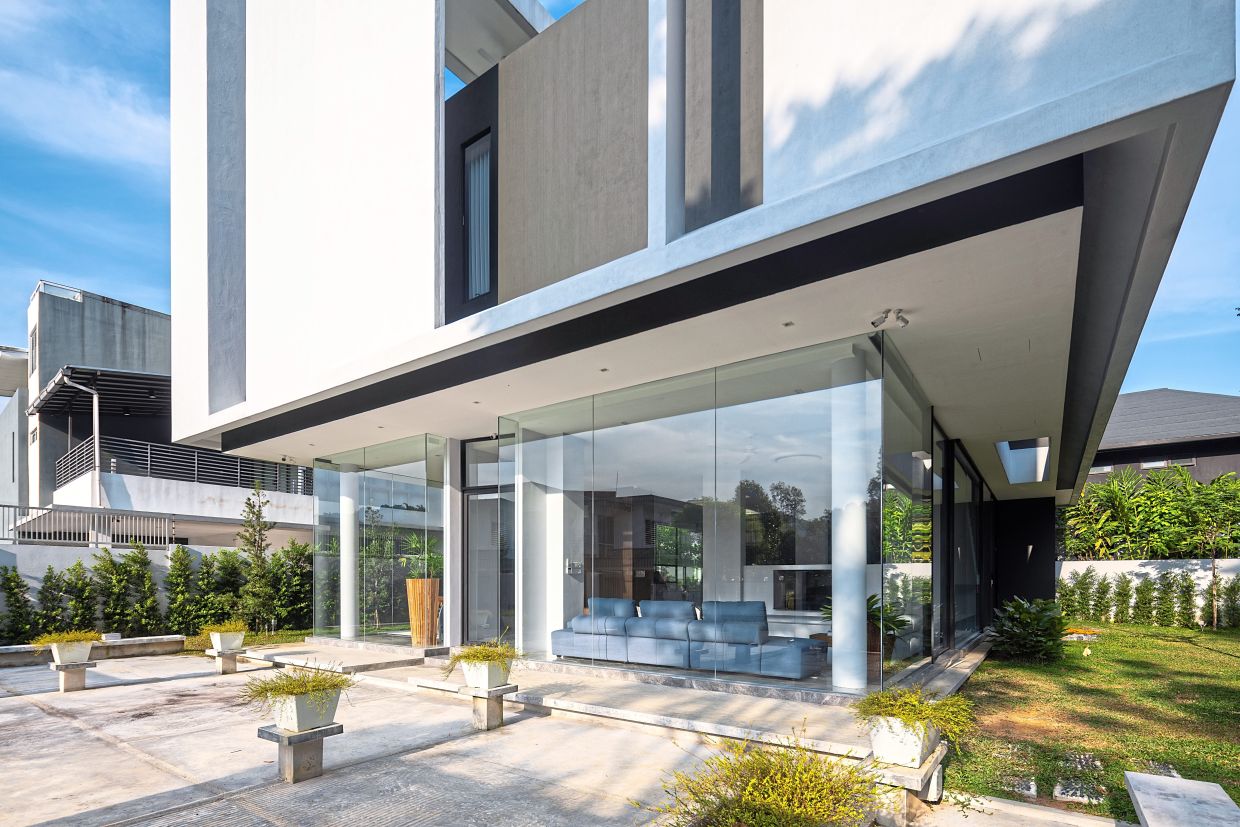
Paradoxically, the floating effect is achieved through weight. Reinforced concrete serves as the primary material, lending mass to the upper volume and enhancing the visual contrast with the transparent base below.
The top floors of the house appear heavier, establishing a deliberate imbalance that heightens the sense of levitation.
“The upper volume acts as a solid anchor,” Looi says. “But within it, voids and extensions allow light to filter through, creating a dynamic interplay of shadow and light.”
From the inside, the experience is immersive.
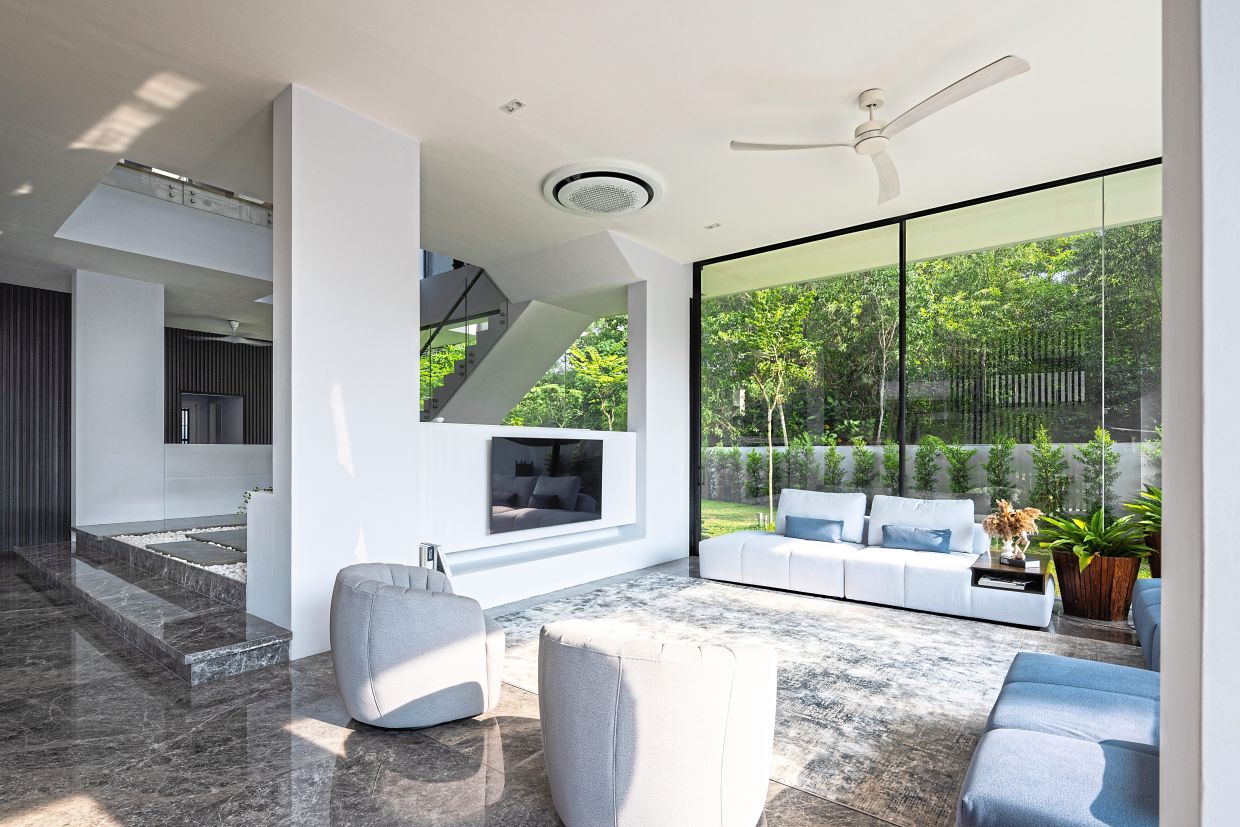
“You don’t see boundaries,” he says. “The whole common area – dining, living, staircase – is angled toward the garden, at almost 270° or even 360°.”
To heighten the effect, the back of the lower level was painted dark grey to visually recede, while the upper volume was kept crisp and white.
“When you see it from the road, your focus is on the white, not the dark shape, so it appears to be floating,” he explains.
“At night, when the lights are on, the effect becomes even more dramatic.”
Achieving the illusion of weightlessness for a concrete structure is no mean feat.
“It’s not exactly floating,” Looi clarifies with a laugh. “There are structural elements, it still has to stand! But we camouflaged them.”
From certain angles, only four visible pillars appear to support the upper floor. In reality, additional structural elements are set back and integrated into walls, carefully concealed to preserve visual lightness.
The challenges extended beyond the main building form.
Looi also designed a secondary facade, a “second skin” composed of vertical fins.
“These fins are arranged to align with more private spaces, ensuring seclusion,” he explains. “At the same time, less frequented areas open up to the landscape, allowing light and views to flow freely.”
Designing this massive second skin posed another challenge.
“We wanted to keep it light, but conventional materials are usually heavy,” he says.
Ultimately, architectural detailing and engineering became a careful negotiation between ambition and feasibility. What made the project successful, Looi believes, was consistency.
“From the first drawings to the end product, everything ran parallel to the concept,” he adds.
“It’s easy to draw something beautiful, but translating that into construction without losing the idea... that’s the hardest part.”
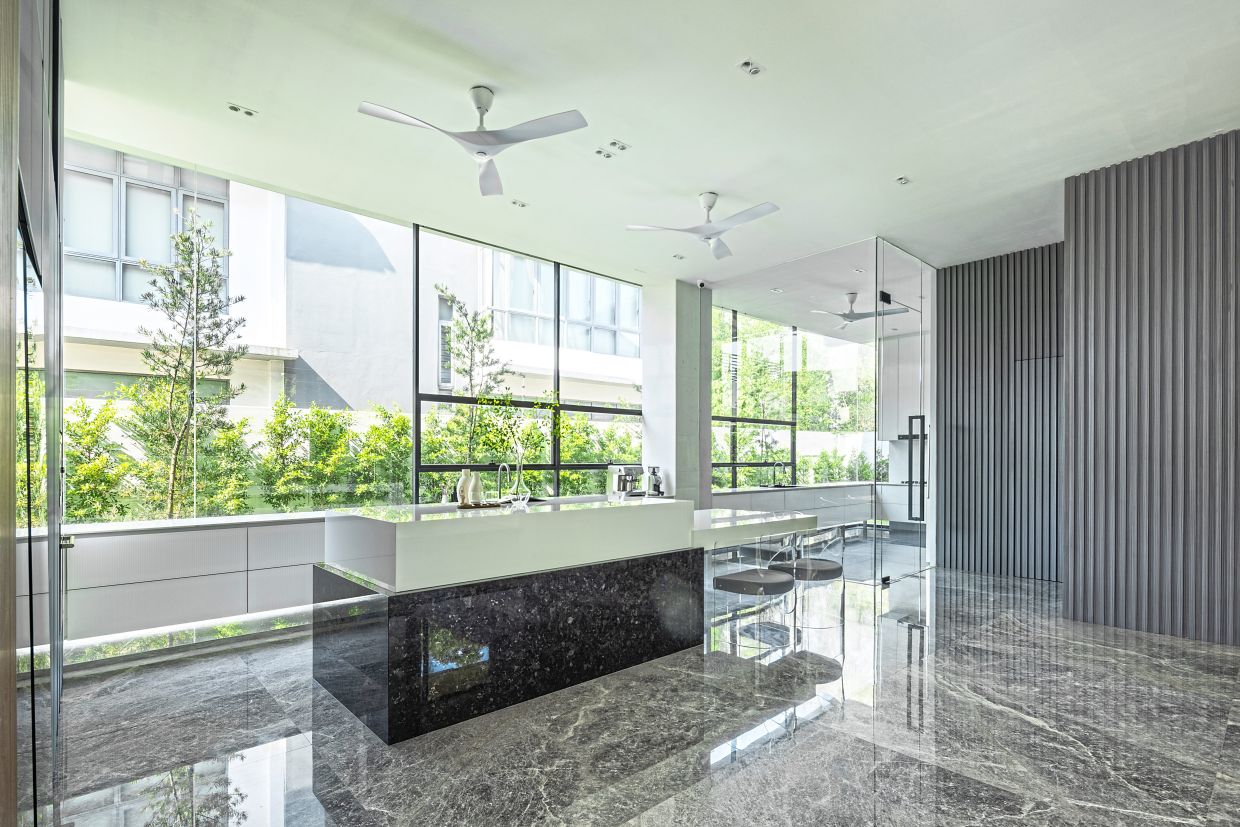
One of the project’s most unexpected highlights is the kitchen, where even the cabinets seem to be floating.
“Usually, kitchen cabinets sit on the ground,” Looi explains. “But here, the cabinets appear to hover.”
To achieve this, the cabinets were cantilevered from the wall using a concealed steel I-beam spanning nearly six metres. Because the glass walls extend all the way to the floor, no visible support could interrupt the visual flow.
“It’s a trick to the eye – like magic,” he says. “Everything is raised about 30cm from the ground, finished on three sides, with the support completely hidden.”
This playful extension of the floating concept reflects Looi’s attention to detail, where even furniture reinforces the architectural narrative.
“People think more detailing is better,” he says. “But less is more because sometimes, overdoing it loses the inspiration.”
“A house stays for 20, 30, even 100 years. So we can’t overdo it, but we also shouldn’t be overshadowed by the neighbours. You need to find a balance; stand out, but not too much,” he adds.
That balance, executed with restraint and confidence, is one reason the house resonated so strongly with the PAM Awards jury.
For Looi, architecture is never just about form and structure – it’s about changing how people live.
“We transform lines into a lifestyle,” he says. “When clients come to us, we want to improve how they live.”
In the Float-Box House, this philosophy manifests itself through thoughtful spatial planning.
Living spaces face the garden, enhancing privacy and serenity. Common areas occupy the open-plan ground floor, encouraging flexible social use. The staircase becomes a dramatic triple-volume vertical journey, linking the main floors to a rooftop deck and half-level bar area.
Bathrooms draw natural light from above, using simple materials and resort-inspired stones to create calm, tactile environments.
Looi’s favourite areas in the house are surprisingly straightforward.
“The front view is my favourite,” he says. “And the living room, that’s where you really feel the openness.”
He also points to the staircase, whose triple-volume ascent frames uninterrupted views of the forest reserve. As one moves upward, the journey becomes experiential, constantly reinforcing the home’s relationship with nature.
When asked to sum up the project, Looi pauses before answering. “Satisfaction,” he says. “Not just for the homeowner, but also for us as the creator and builder.”
“From planning to completion, there were very few changes. It was consistent planning and implementation all the way,” he concludes.
Levitating but grounded
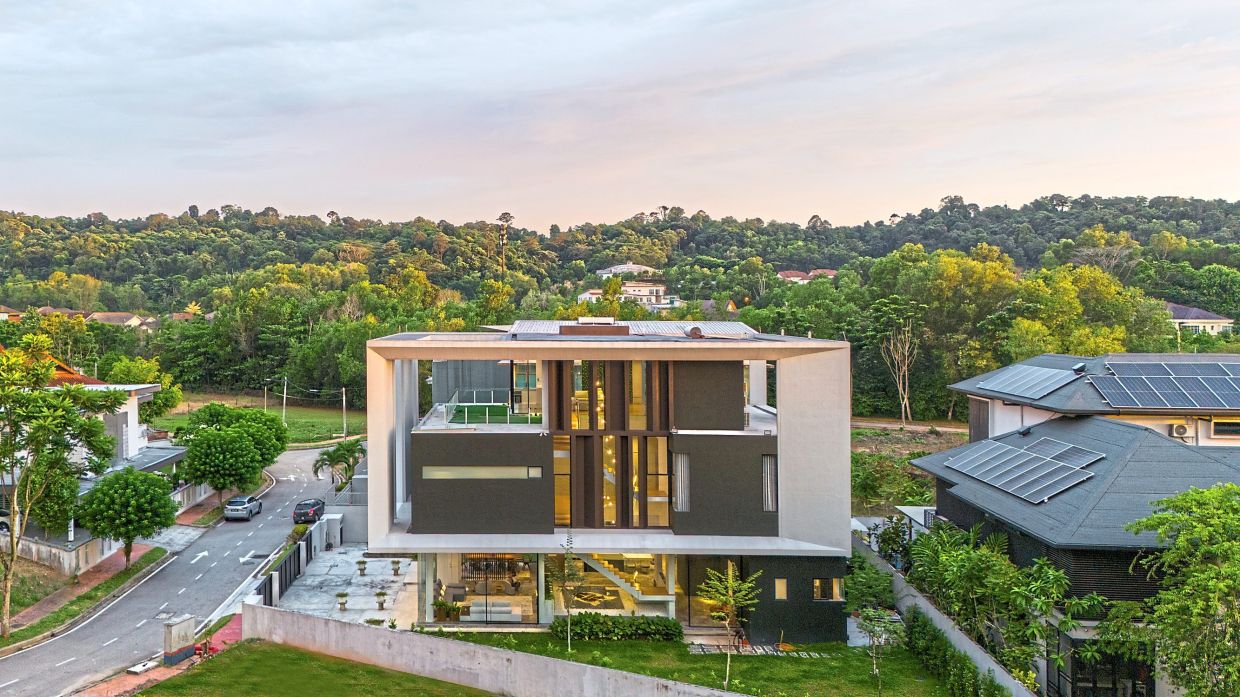


The Float Box House (side view) is located on an angular plot of land surrounded by the lush Kota Damansara Forest Reserve. Photos: MK Looi Architect
Vertical fins shield the most frequently used spaces, while opening up less-frequently areas to expansive views of the forest reserve.
A large white box envelops smaller dark boxes, the former serving as the unifying form, while the darker ones contain spaces within the structure.
The dry kitchen with an island in the middle, and the ‘floating’ cabinets along the glass wall.
The living room on the ground floor has subtle hidden pillars, making the support seem ‘invisible’, creating the ‘floating’ illusion.
The staircase connects the first and second floors while vertical landscaping merges the interior and exterior.
View of the living room on the ground floor from the garden. On the left is the living room and on the right is the guest room lounge.
The luxurious chandelier hanging from two and a half storeys above, next to the central staircase.
The living room is surrounded by glass walls so it isn't obvious the structure is there, from the outside. The result is this floating effect.
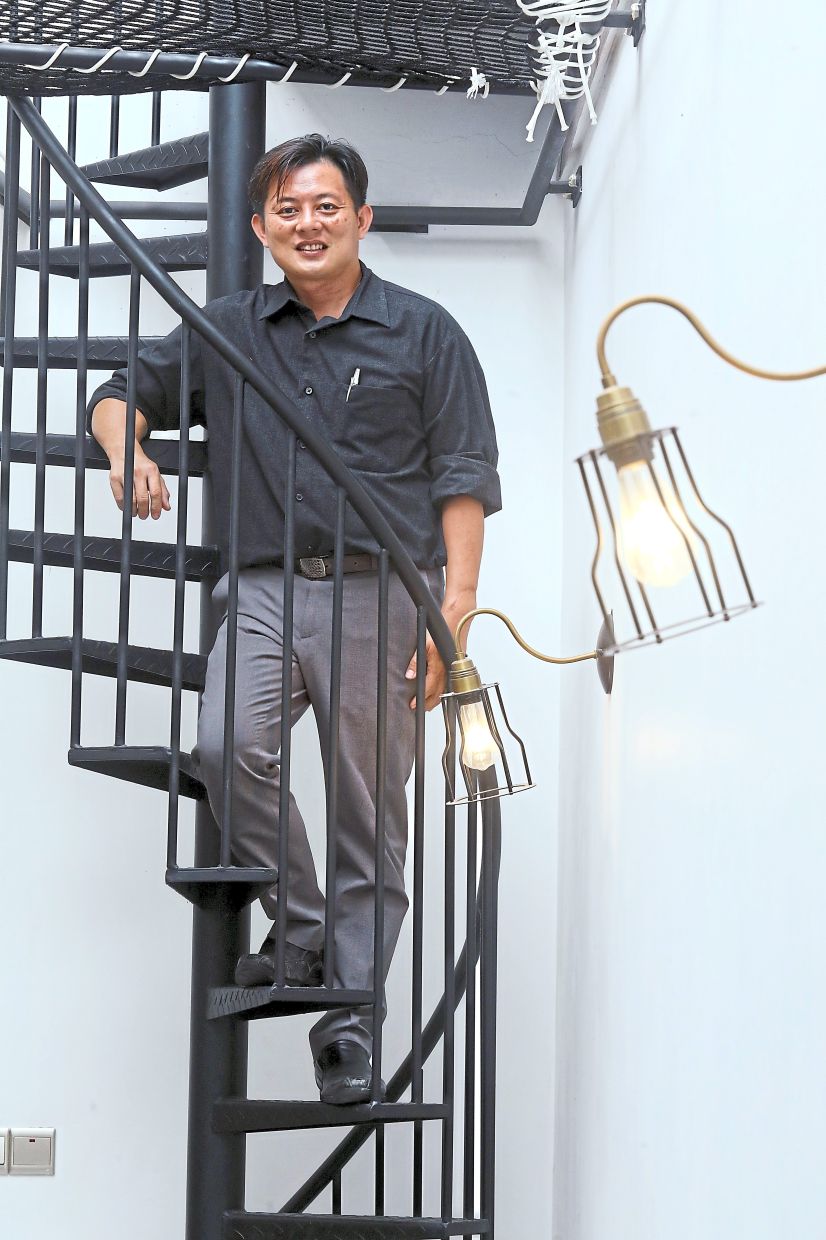
Looi says architecture is about changing how people live. Photo: The Star/Azlina Abdullah